Παρασκευή 22 Μαΐου 2015

The Testament.

Ειμαστέ αισιόδοξοι. Το τέλος της Ιστορίας δεν ήρθε, ουτε θα έρθει. 
Ο κόσμος που ζούμε μπορεί να αλλάξει και θα αλλάξει. Είμαστε σίγουροι για αυτό... 

We are optimist. The end of History didn't come, neither it will.
The world we live in can be changed and it will be changed. We are sure about that...

C. Florakis (captain Yiotis), somewhere on the Greek mountains,
during the Greek civil war (1946 - 1949)


"The farmers leave! The sowing remains! And growing. And becomes bigger. And blossoms. And throws new seeds on the earth. And the circle repeats. That's how the generation of 1912 - 1913 thought, that it's the last heroic generation. And what would happen to the land when they will be gone. But then came the generation of '40, the new sowing and raised the struggle's flag even higher. The same says every generation identifying in itself the history. And forgets the sowing. That is coming too far from the past and goes deep into the future. You see, foolish, the youth around you that you think they have lost their path and have been compromised. You have no idea! Once there is a sparkle, these youth will turn into a fire, a volcano. And they will be proved way better than their fathers’ and grandfathers’ generation was. And they will raise the struggle's flag all the way to the Sun. It's the sowing, i am telling you... "

G. Alexandrou (Diamantis) & C. Florakis (Yiotis),
commanders of the 1st and 2nd division of
Democratic Army of Greece (Δ.Σ.Ε).
Karpenisi, Central Greece, January 1949
On Trial, Athens May 1960
After 26 years the Communist Party of Greece (KKE) is legal once again.
C. Florakis giving his first interview to the press as General Secretary of KKE.
Athens, 26.8.1974
M. Theodorakis, G. Ritsos & C. Florakis attend the commemorations
for the one year from the Polytechnical School Uprising.
Athens, 17.11.1974
C. Florakis addresses the Serbian people during the NATO bombings.
Belgrade, 23.4.1999

"I do not name this paper testament, for the reason that i have nothing to dispose. All i had i gave it to the Party, the Communist Party of Greece, with its known symbols, the ideology of Marxism-Leninism, its program and its principles. Politically, i also have nothing to leave. Everything i had to offer, i did it through my specific action. Give political advice, i do not consider it serious. I want to return and be buried to the place i was born. In Paliozoglopi and specifically at St. Ilias, to have better view. The tomb has to be simple, just be fenced, so it can't be easy for the wild animals to dig me out. I don’t want speeches and wreaths. All these, instead, to be expressed as support to the Party."

September 1994,
Farewell,
Charilaos Florakis

One last goodbye. Rachoula, Agrafa Mountains, 26.5.2005


In memory of Charilaos (20.7.1914 - 22.5.2005).
10 years after...

Σάββατο 9 Μαΐου 2015

Victory!

"Κάθε άνθρωπος που αγαπά την ελευθερία,
χρωστάει στον Κόκκινο Στρατό περισσότερα 
από ό, τι μπορεί ποτέ να πληρώσει"
Έρνεστ Χέμινγουεϊ

"Every man who loves freedom,
owns to the Red Army much more
than he can ever payback"
Ernest Hemingway


"We are in Berlin: the darkness of the century, the darkness for many countries, the darkness of consciousness and logic is over. Berlin was the symbol of evil, the death's nest, the hotbed of violence. From Berlin flied the vultures to Guernica, to Madrid, to Barcelona. From Berlin started the phalanxes that trampled the gardens of France, that mutilated the antiquities of Greece, that tortured Norway and Yugoslavia, Poland and Netherlands. By reaching Berlin we didn't save only our country, we saved civilization. If is meant to be a new Shakespeare to be born in England, if a new Delacroix will ever exist in France, if came into flesh the dreams of the greatest minds in humanity, a new golden century, this will be possible because the comrade Sidorov, right now, walks in the streets of Berlin, next to the beerhouses  and the barracks, next to the torture's chambers, next to the workshops that knitted "perfect made" hammocks out of women's hair..."

Ilya Grigoryevich Ehrenburg, 27.4.1945

Kurisnsky. Tania (The Feat of Zoya Kosmodemyanskaya). 1947
S. Gerasimov. Partisan's Mother. 1943
A. Deineka. The Defense of Sevastopol. 1942
P. Krivonogov. Victory. 1945
"It's easier to write now, much easier than October of '41: because if grief is silent, joy never skimped the words. And our hearts are full of joy. The tragedy of the 20th century is about to end: We are in Berlin! All this started from something meaningless: The Reichstag burned to the ground by the fascists. This is coming to an end exactly at the same place: Berlin is in flames! 
Justice moves slowly. Its path is spiral. Took years of hard ordeals and hardships, the ashes of Warsaw, of Rotterdam, of Smolensk, before the arsonists meet Nemesis."

Ilya Grigoryevich Ehrenburg, 27.4.1945

A Soviet junior political officer (Politruk)
urges Soviet troops forward against German positions. (12.7.1942)
Victorious Soviet soldiers in Berlin, May 1945.
“Nobody really wanted to die that night because the war was already won,” he declared. “Even a promise by our officers that those who captured the building would get the highest decoration of Hero of the Soviet Union called forth few volunteers. Except for my little company.” The four men G. Zagitov, A. Lisimenko, A. Bobrov and M. Minin made their way towards the Reichstag they were met by heavy fire.

Running in front was Giya Zagitov, who had a flashlight with him. That flashlight helped us to pass through the damaged stairs. All the corridors linked to the stairs were cleared by grenades and long sub machine gun bursts. Right before reaching the attic I tore a one and half meter pipe off the wall to serve as a flagpole. After reaching the spacious attic, we faced the problem of getting to the roof. Again G. Zagitov found a solution - with his flashlight he noticed in the darkness a heavy winch and two chains going to the top. We climbed the chains and then through a tiny window got out to the roof somewhere on the western side of the building. There near a barely noticeable column Zagitov and i began setting up our Red Banner. Suddenly an explosion lighted up the roof and Lisimenko found our old reference-point - a sculpture of a bronze horse and a large woman in a crown. It was immediately decided to set the banner on the sculpture.

The guys raised me onto the horse’s back which shook from the explosions, and then I fixed the banner right in the crown of the bronze giantess.

We checked the time. It was 22:40 local time. 30th of April 1945..."

The Building in which signed the surrender of German Forces.
Karlshorst, Berlin, 9.5.1945
Few days later, the night from 8th to 9th of May, in a villa in the neighborhood of Karlshorst, the Colonel-General Hans-Jürgen Stumpff (Luftwaffe), Field Marshal Wilhelm Keitel (Chief of Staff of OKW) and Admiral Hans-Georg von Friedeburg (Commander-in-Chief of the Kriegsmarine), sign and deliver to Field Marshal  Georgy Zhukov  the unconditional surrender of the German military forces. After 6 destructive years the war in Europe came finally to an end. The beast was dead...

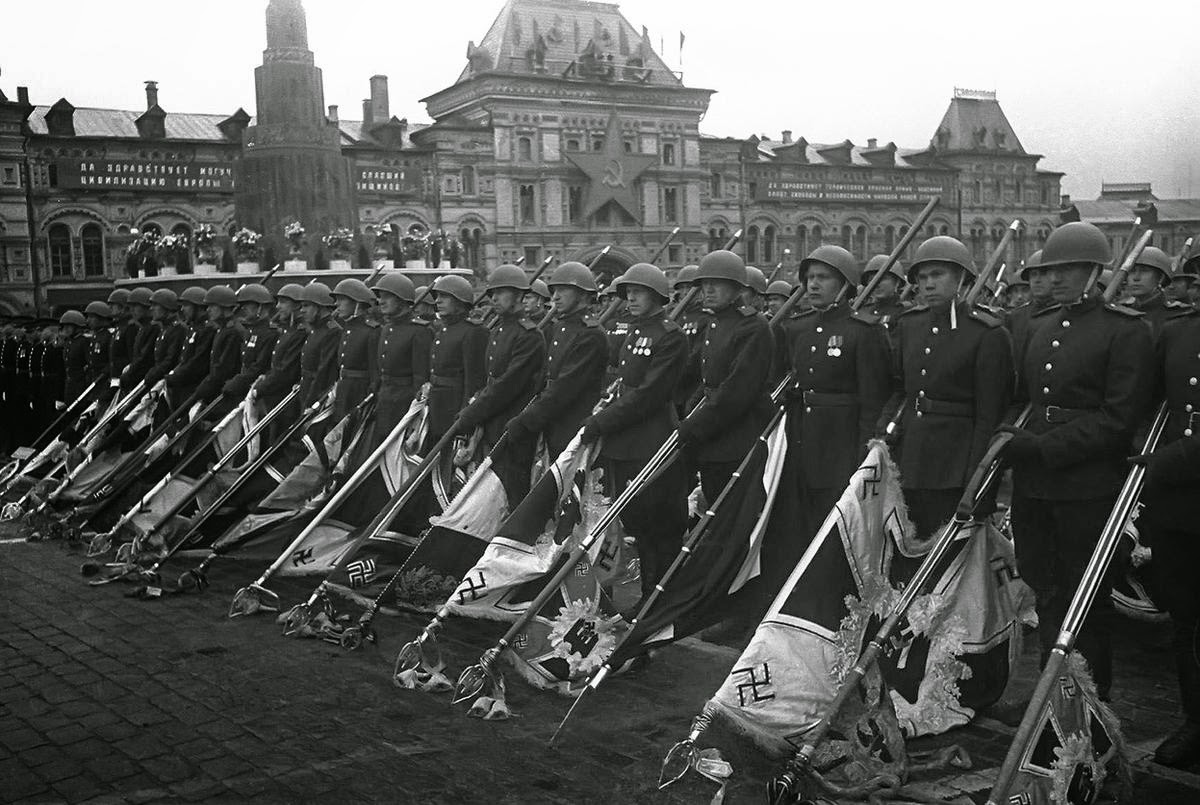
Victory Parade, Moscow, 24.6.1945
Detail of the Soviet War Memorial Treptower Park,
Berlin, April 2010
Today, exactly 70 years after that day. The day of surrender. 70 years after the defeat of the Nazist - Fascist hordes, the effort to rewrite history is more intense than ever. The aspiring distorters and counterfeiters of history know very well that the preservation of  the collective memory has not so much to do with the past, as it has to do with the present and the future. So do we! And every year, this specific day, we will repeat loud and clear that: 

"If someone examines the corpse of fascism, he will see that has many wounds, from simple scratches to deep injuries. But only one wound was deadly and this was caused by the Red Army."

"The Homeland will never forget their heroes".
Soviet War Memorial Treptower Park, Berlin, April 2010


Struggle against oblivion. Struggle for today and tomorrow!
Carlos Latuff, May 2015
In memory of the Great Antifascist Peoples' Victory.
 In memory of Man!

Τρίτη 14 Απριλίου 2015

Τhe Ιncident Dissolved


Don't forget, commemorate our poet
Vladimir Mayakovsky.
Forty six years ago he left away from us
How Mayakovsky is related?
In the factory, an old comrade from Macedonia used to talk about him
Sometimes on Sundays, as we were drinking raki from homeland 
and singing songs about migration and resistance
He had lived i Russia for many years
And he used to take the book with Vladimir's poems
As he was calling him
And he was reading to us
And he was bringing in mind the other Vladimir
And he was in tears sometimes
But i think i said enough
Farewell once again

(The October's poem, Y. Ritsos, 1976)

Vladimir V. Mayakovsky. July 19, 1893 - April 14, 1930 

On 14th of April 1930, at the age of 36, Vladimir Vladimirovich Mayakovsky 
committed suicide by shooting himself through the heart. In his death note we can read among other:

And so they say - "the incident dissolved"
 the love boat smashed up 
on the dreary routine.
I'm through with life 
and [we] should absolve
 from mutual hurts, afflictions and spleen.

Πέμπτη 19 Μαρτίου 2015

The Spacewalk

Drawing inspired by Alexey's Leonov spacewalk
On the morning of 18 March 1965, the cosmonauts were woken up for their flight. They were given a medical and then observed several traditions that had developed in the years since Gagarin’s launch. Yuri opened a bottle of champagne and poured it into glasses for the cosmonauts to sip. Then they signed the bottle, making a pledge to drink the rest on their return from space. Afterwards, they urinated on one of the wheels of the bus used to transport them to the launch pad at Baikonur. At 07.00 GMT, the R-7 rocket’s engines ignited and propelled the two cosmonauts into the sky. 

Upon reaching orbit, Belyayev deployed the airlock while Leonov strapped on his life support system. Then, with a slap on the back from Belyayev to see him off, Leonov crawled into the airlock and closed the hatch behind him. Leonov waited patiently while Belyayev equalized the pressure in the airlock with the zero pressure in space. This would help purge nitrogen gas from Leonov’s body, protecting him against decompression sickness, also known as “the bends”. Eventually, the all-clear was given to open the external hatch. As Leonov looked out at the Earth, night was turning to day, and Africa filled his field of view...

We established contact over the Black Sea. Yuri Gagarin was on the other end.
"Almaz, you can step out, we see you well". And i jumped.

Alexey Leonov's walk lasted for 12 minutes and 9 seconds.

“As soon as we were in orbit the command was given to open the airlock. I went out the airlock and the hatch was closed behind me. It's hard to imagine what it is like. My feeling was that i was a grain of sand. Only out there can you feel the greatness and enormity of all that's around us. On Earth you just don't get a sense of it... The silence struck me. I could hear my heart beating so clearly..." 

...It was then that things began to go wrong. I felt my spacesuit losing it's shape. My fingers had slipped out of the gloves and my feet from the boots. The suit felt loose around my body. So i had to do something. I couldn't reel myself in on the cord. It was impossible in these gloves. And if i stayed like this i just wouldn't fit back through the airlock. But worst of all, five minutes more and i would be in the Earth's shadow and i wouldn't be able to see anything at all. Silently, without reporting to ground control i decided to halve the pressure in my suit..."

Pavel Belyayev and Alexey Leonov during the Voskhod 2 mission.
Pavel Belyayev and Alexey Leonov back on Earth
Yesterday (18.3.2015) marks exactly half a century since mankind took a daredevil leap into open space... The Soviet cosmonaut Alexey Leonov performed the first extravehicular activity in human history, as a part of the Voskhod 2 Soviet manned space mission, adding another milestone in the exploration of space! The two cosmonauts returned safe to earth the other day, March 19, 1965, 09:02:17 UTC.

Alexey Leonov on 1965 USSR 10 kopek stamp. 

Τρίτη 16 Δεκεμβρίου 2014

The Guide...

Άμα σώπασε ο Οδηγητής, όλες οι άλλες φωνές και ψυχές 
ενωθήκανε σε μία και λένε το ακόλουθο τραγούδι.
             
     
               Δεν είμαι εγώ σπορά της Τύχης               
ο πλαστουργός της νιας ζωής
Εγώ είμαι τέκνο της ανάγκης
κι ώριμο τέκνο της Οργής.

Δεν κατεβαίνω από τα νέφη
γιατί δε μ’ έστειλε κανείς
Πατέρας, τάχα παρηγόρια
για σένα, σκλάβε, που πονείς.

Ουράνιες δύναμες, αγγέλοι, 
κρίνα, πουλιά κι ψαλμουδές 
τίποτα! Εμένα παραστέκουν
οι θυμωμένες σας καρδιές.

Εγώ του καραβιού γοργόνα
στ’ ορθόπλωρο καράβι μπρος.
Απάνω μου σπάνε φορτούνες
κι άγριος ενάντιά μου καιρός.

Μέσα στο νου και στην καρδιά μου
αιώνων φουντώσανε ντροπές
και την παλάμη μου αρματώνουν
με φλογισμένες αστραπές.


Ένας δεν είμαι, μα χιλιάδες!
Όχι μονάχα οι ζωντανοί 
κι οι πεθαμένοι μ’ ακλουθάνε
σε μια αράδα σκοτεινή.

Μα κι όσοι αγέννητοι, χιλιάδες
άπλαστοι ακόμη με βλογούν
κι όλοι ακουμπάνε τα σπαθιά τους
απάνω μου και τα λυγούν.

Δε δίνω λέξεις παρηγόρια
δίνω μαχαίρι σ’ ολουνούς
καθώς το μπήγω μες το χώμα
γίνεται φως, γίνεται νους.

Άκου, πως παίρνουν οι αγέρες
χιλιάδων χρόνων τη φωνή!
Μέσα στο λόγο το δικό μου
όλ’ η ανθρωπότητα πονεί.

Ω! πως τον παίρνουν οι αγέρες
και πως φωνάζυμε μετά
άβυσσοι μάβροι, τάφοι μάβροι
ποτάμια γαίματα πηχτά!

Όθε περνά, γκρεμίζει κάτου
σαν το βοριά, σαν το νοτιά
όλα τα φονικά ρηγάτα
θεμελιωμένα στην ψευτιά.

Κ’ ένα στηλώνει κι ανασταίνει
το `να βασίλειο της Δουλειάς
(Ειρήνη! Ειρήνη!) το βασίλειο
της Πανανθρώπινης Φιλιάς.

Κώστας Βάρναλης, "Το Φώς που καίει", 1922


I was not born out of chance
Not the creation of those who are young
I'm but the child of your needs
and the mature state of your rage.

I'm not descending from the heavens
for no one sent me out of nowhere.
I am the father, nay, the comfort
for you, slaves, who feel my pain

Heavenly forces, angels
lilies, birds and psalms -
it all means nothing! For my ally
are your own enraged hearts

I am a vessel's wooden mermaid
nailed on the bow of a seaworthy ship.
Meant to rise up to the toughest tides
the fiercest weather that opposes you.

Inside my mind and in my heart
centuries of disgrace have broken out 
and they are arming my hands
with lighting bolts fiery proud.

There's more than one, there are thousands!
And not just the ones still alive -
our proud dead follow in my footsteps
in a dark never-ending line.

But even thousands still unborn
people still not of this world.
They bless me, raise their swords
and rest their faith unto me.

But I'm not here to give no comfort
I'm showing everyone the sword
and as I force it to the ground
it turns to mind it turns to gold.

Listen how the winds swept away
words told for hundreds of years!
In the words I want tell you
you'll find all of humanity's grief.

Oh! how the winds swept it away
but still years after it's still said
About black abysses, darkened moats.
About rivers running red with blood. 

Here it comes and crushes down,
like the strongest north or south wind
all the murderous forces
founded on lying and deceit.

And only one thing can come from it
the one and only kingdom of Workers
(Peace! Peace!) this is the kingdom
of solidarity for the whole world.

Kostas Varnalis, "The Burning Light",1922


In memory of  the great Greek communist poet, Kostas Varnalis 
14.2.1884 - 16.12.1974

Τετάρτη 3 Δεκεμβρίου 2014

The Great December...


"When people stand upon the danger of tyranny 
chooses either the chains or the arms"


Athens, Syntagma Square, 4.12.1944
It was a Sunday exactly 70 years ago when a peaceful protest of EAM (National Liberation Front) was turned into a massacre. It was the beginning of the, 33 day long battle, of Athens. It was the day that the people of Athens chose again to pay the big price of blood in order to preserve its dignity and freedom. Freedom that had been won with countless sacrifices during the Nazi occupation that lasted more than 3 years (21.4.1941 - 12.10.1944). This time an "ally" was about to be the enemy... 60.000 British troops provided the best support to the Greek bourgeoisie class in order to achieve its goal. To come back to power no matter if this was fully against people's will! Greece became the only land in post war Europe (together with West Germany) that the ex - collaborators of the Nazis not only didn't get punished for their crimes against the people but also became an organic part of the postwar state.

Athens, Corner of Panepistimiou & Vas. Georgiou, 3.12.1944 (28 armless protesters murdered on that day)
The funeral of the 28 protesters of the 3rd of December. Athens, Singrou Ave. 4.12.1944
"Nothing can yield Athens"
Upon the danger of a new Tyranny people of Athens chose the arms and not the chains. For 33 days gave a heroic and unequal battle. But it didn't win. It didn't win only in military terms. It was the moral and ideological winner of this battle. Today the peoples all around the world seems that have chosen the chains. The only thing is that a minor part can feel these chains as it moves and tries to break them! Using a Rosa's Luxembourg quote "Those who do not move, do not notice their chains".

Syntagma Square in Athens, as seen from the rooftop of Grate Britain hotel, during the battles of  December 1944


«Αστραποβολά ο λαός μέσα στις συνοικίες.
Με μια ψυχή πέτρες λοστούς και σίδερα κινεί.
Για πολεμίστρες στους εχθρούς πυργώνει τις γωνίες.
Κι από τα οδοφράγματα η Λευτεριά θ' αρθεί».


Τρίτη 11 Νοεμβρίου 2014

The Trumpet

Vasilis Douridas, "Atilio", 1942 - 1994
I never learned his name. I didn't know anything about him. How old was he, if he was married or had children, where and how he lived. I never heard his voice. We had never talked. But we were together for more than 20 years. We were seeing each other every Sunday or Wednesday sometimes, no matter how the weather and the situation was. His trumpet was like the "The Magic Flute" in the fairy tales. When he was starting, thousands of voices were becoming as one, the torches were firing and the hearts were beating faster. A distant but lonely journey started for thousands, a breakout, a denial for everything was concerning us that moment.

Day by day, this music, the trumpet's march moved me more and more. As a child, later as teenager, when i was serving my duty, when i was on the road or at work, something was changing within me as i was listening this tune from the radio. Now the trumpet silenced. Our orchestra became poor. This note is a goodbye to Atilio, the musician of the stadiums, the man who put music in every cry for "GOAL". And if someone say that this is an exaggeration to write an article for Atilio, for Gate 7, for football it's better not to think of hooligans and violence, of fixed matches and bad referees. He can think of the kids, the teenagers but as well as the grown ups who love the beauty of sports, the ones who live in the bright side of the moon , who can make this lonely journey even if they are surrounded by thousands others in the same stand. They will always hear, from somewhere far away, the sound of Atilio's trumpet.  

Article of  M. Vintiadis at newspaper "Τα Νέα", 12.11.1994

Every time that Atilio was blowing his trumpet,
everything were stopping and the hands were rising!
The trumpet was resounding throughout the stadium.
And still does...
The trumpet of Vasilis Douridas (aka Atilio) silenced on a day like this 20 years ago. He will always be remembered as the best example of love and dedication for his beloved team, as a symbol of an era that's no longer exist... 

Τρίτη 7 Οκτωβρίου 2014

The Revolt.


...But he who has seen the slain
Writhing in final pain
Under the blood-drenched sword.
He knows of better realms...


Saturday, 7th October 1944, Auschwitz camp was upset. The silence of the sunny autumn day was interrupted by sudden gunshots and the siren's howling, which this time was not a warning for another air raid, as usual. A column of fire and smoke was coming out from the building of crematorium no. 4. Terrific news were spreading across the whole camp: The Sonderkommando prisoners mutinied! They rebelled with guns in their arms and they fight against the SS.

Cremation of bodies by the Sonderkommando,
Auschwitz - Birkenau, August 1944.
 (Photo taken secretly by the camp's resistance network) 
The revolt was preparing for a long time before October 7th. Already since summer of 1944 member of Sonderkommando were gathering tools, ammunition, grenades and light weapons for a possible future assault against the SS. The leader of this first attempt for organizing, a Lithuanian prisoner (who was serving as a Kapo) called Kaminsky, had been betrayed and executed by the Nazis. The operation had been postponed for a few weeks but it continued after a while when the circumstances allowed it. As the Soviet Army was advancing towards Krakow the, almost 800, prisoners working in Sonderkommando were a serious threat for the administration of the camp. These prisoners were the only (not Nazi) eyewitnesses of the extermination process which was taking place in Auschwitz - Birkenau. They couldn't work anywhere else inside the camp and no one should be stay alive. The SS were saying ironically that they have secured a ticket to paradise! 

The underground resistance movement which was active in the Auschwitz complex was planning a general uprising involving every part of the camp. The Sonderkommando prisoners, as they had nothing to loose, were the chosen ones to light the fire of this uprising, but they had to wait few more days before all the necessary preparations were completed. 

The exterminate fury of the Nazis changed the plan of the resistance's organisation. Sonderkommando had to act immediately as it was facing its total extinction! Already 300 prisoners had been secretly exterminated on September 29th and the same fate was waiting the rest of them few days later... The morning of 7.10.1944 the resistance group had a secret meeting about the last details of the revolt. A Kapo wearing a green armband (stands for native Germans, common criminals) comes accidentally into the room. That was! Some prisoners threw him alive into the oven as others took out the hidden weapons and got defensive positions in the small forest behind the building. Crematorium no.4 had already been in flames! 

The revolt had begun! Prisoners from Crematorium no.2 got into the fight too. For the rest hours few hundred prisoners were facing heroically almost 3000 SS units. 200 hundreds prisoners will fall in that battle for freedom and only few will manage to escape the camp...


The next days a true witch-hunt will take place in Auschwitz. The SS wanted to find out any possible information related with the organisation of the revolt. They failed completely... Noteworthy was the attitude of four female prisoners working in the nearby "Union" factory (owned by the Krupp family). They were accused for smuggling gunpowder to the resistance members. Despite months of beatings and rape and electric shocks to their genitals, the only names given up by the women are those of already dead Sonderkommando. On January 5, 1945, the four brave women are hanged in front of the assembled women’s camp. One of them, Roza Robota shouts “Be strong and be brave” as the trapdoor drops.

Women being taken to the gas chamber,
Auschwitz - Birkenau, August 1944.
(Photo taken secretly by the camp's resistance network) 
The revolt in the Birkenau crematoriums was the only armed conflict took place in Auschwitz and one of the few known acts of resistance that happened in the huge network of the Nazis concentration camps. The political and moral impact of this action was enormous. It raised the spirit of the inmates and made them to trust their own powers. Their belief to victory became stronger. The revolt showed that even a small group of prisoners, despite their condition, can face thousands fully armed SS. As the Nazis couldn't reinforce the SS guard of the camp, they forced to abandoned their primary plan for the massive extermination of the prisoners and they evacuated the camp instead.We can claim, even if it can not been proved, that the revolt of Sonderkommando put a premature end to the extermination process of this death factory, saving thousands of lives.  


... And yet i 'd rather die,
Your spittle in my eye,
Rather die as a coward,
Than have blood on my hands...

Πέμπτη 18 Σεπτεμβρίου 2014

Black Dawn...

«Απ’ τα τσακάλια δε γλιτώνεις με εύχες ή παρακάλια».
K. Βάρναλης

Congress of the German Antifascist Action, Berlin 10.7.1932

"Fascism is a historic phase of capitalism; in this sense it is something new and at the same time old.
In Fascist countries capitalism continues to exist, but only in the form of Fascism; and Fascism can be combated as capitalism alone, as the nakedest, most shameless, most oppressive, and most treacherous form of capitalism.

But how can anyone tell the truth about Fascism, unless he is willing to speak out against capitalism,which brings it forth? What will be the practical results of such truth? Those who are against Fascism without being against capitalism, who lament over the barbarism that comes out of barbarism, are like people who wish to eat their veal without slaughtering the calf.

They are willing to eat the calf, but they dislike the sight of blood. They are easily satisfied if the butcher washes his hands before weighing the meat. They are not against the property relations which engender barbarism; they are only against barbarism itself. They raise their voices against barbarism, and they do so in countries where precisely the same property relations prevail, but where the butchers wash their hands before weighing the meat."

(Bertolt Brecht - Writing the Truth: Five Difficulties, 1935)


Graffiti in Barcelona. In memory of Pavlos Fissas


Το φασισμό πάτα στο λαιμό...
Για τον Παύλο (10.4.1979 - 18.9.2013)

Τετάρτη 13 Αυγούστου 2014

The "Neo-Hellenic" Dream!


Date: 13.08.2004
Time: 21.00
Place: Athens Olympic Stadium 

Phevos & Athena (Mascots of the 2004 games) 
It was exactly 10 years ago, in a full of 72.000 spectators, Olympic Stadium in Athens when a female announcer was "welcoming the citizens of the world in the fest of Athens". The 28th Olympiad was about to begin. It was the day that the "Neo-hellenic" dream reached its highest peak! It was the day that the "average" Greek citizen was "filed up with National Pride" for the achievements of his "strong" country. (Ισχυρή Ελλάδα / Ischiri Ellada, that's how the ones who were in power back in the days used to call the land). Few years ago the country had became a member of a Euro-zone, the statistics and the indicators were clear: everything was going up. His beloved homeland was the strongest in the area, even his national team was on top of the European Football. He had no doubt: the future belonged to him and nothing could stop it...

G.A.Daskalakis (President of the organizing committee) with J. Rogge (president of the International Olympic committee) during the games


Increasing of the repression in the name of security (involving even NATO), austerity measures, economical scandals (officially the cost of the games estimated up to 8.5 billions Euro when the real cost is still unknown) everything was acceptable in the name of our "National Challenge". Just few years after the same "average citizen" was trying to figure out what went wrong and the things end up the way they were. It was the period that he experienced the best possible way how "expensive" was his old dream seeking  the answers by yelling about thieves and traitors, complaining for corruption and immigrants and voting for Neonazis... He knows he was / is also guilty of all the things are still going on in Greece nowadays but he never was brave enough to admit it! For him the "We all together..." become the alibi he was looking for in order to make peace with his consciousness... 

The day the war will be declared inside him the hope for a real change will rise again! Til then we have to make clear that the dreams were / are NOT the same for everyone of us... 

Protest organized by trade unions in memory of the dead workers of the Olympiad, Athens 10.08.2004

In memory of the 13 dead workers (Greek and Immigrants) who helped the "dream" come true... 

Christos Miamis (62)
Kotsi Astrit (35)
Vangelis Meri (45)
Manea Marinel (32)
Alexis Batsi (32)
Thanassis Papagiorgis (45) 
Krekou Yianni (29)
Michalis Evangelou (46) 
Elias Mauropoulos (48) 
L. Marinakis (29)
Panagiotis Mpolanis (58)
Ntoka Ntalip (51)
Sotiris Sekas (51)