Εμφάνιση αναρτήσεων με ετικέτα World War II. Εμφάνιση όλων των αναρτήσεων

Παρασκευή 27 Ιανουαρίου 2017

We, the Dead, Accuse!

 
No crosses rot upon our graves,
No headstones gently lean
No lattice wrought or twined wreaths
No bowing angels screen. 

No willow tree or gold-writ rhyme
No candle never quenched 
We rot in pits, white-splashed with lime
With rain our bones are drenched
Our whitened skulls without defense
Trembled on barbed wire fence
Our scattered ash fills may an urn
Ans still the bodies burn.

A chain we are, which the earth wears
And the wind blows like seed,
We count the days and months and years
We know not time nor speed.
Our numbers grow by day and night
We swell beneath your ground
And upward press until our might
Will burst our earthly bound.
Then skull to skull and bone to bone
We 'll mount the judgment throne
And bring to all the fearful news:
Lo! We, the Dead, Accuse!

The following is one of two poems written on 8.3.1944 by an unknown female Jew prisoner of Czech nationality, on her way to crematorium in Auschwitz II - Birkenau. The note with the poems handed by a Sonderkommando prisoner and then smuggled out of the camp to Prague. 


Στο μνήμα μας επάνω δε θα βρεις σταυρό,
ούτε πολυκαιρίσιες πλάκες ραγισμένες.
Δε θα βρεις άνθη, μήτε κάγκελα από σίδερο χυτό,
ούτε και Χερουβείμ με παναγνές μορφές θλιμένες.

Κεριά δε στάζουν πάνω μας δάκρυ καφτό.
Κι ο ίσκιος του κυπαρισιού είναι μακριά μας.
Μ' άσβεστη ποτισμένοι λιώνουμε στους λάκκους μας σωρό
και μόν' ο άνεμος σφυρίζει αγριωπός στα κόκκαλα μας.

Άσπρα κρανία κρεμασμένα δω κι εκεί
πάνω στους φράχτες με το σύρμα τ' αγκαθένιο.
Κι η στάχτη μας σκορπά και χάνεται κι αυτή
στους πέντε ανέμους - σύννεφο ασημένιο.

Σ' απόκοσμη διαβαίνουμε αράδα σκοτεινή,
σπόροι που μας κυλά το φύσημα τ' ανέμου.
Κι όλο μετρούμε: μήνες - χρόνοι μακρυνοί,
καθώς, προσμένουμε το τέλος του πολέμου.

Στρώμα το στρώμα αυξαίνουμε και πιο πολύ
μέσα στου λάκκου τ' αγριο, πηχτό σκοτάδι.
Αδιάκοπα η σάρκα μας χορταίνει σας τη γή.
Θε να ρθει όμως η στιγμή να σπάσει η θύρα του Άδη.

Τότε θα βγούμε - λιτανεία φοβερή 
σκελετωμένα κόκκαλα. Κι όπως θα προχωρούμε
Θε ν' αντηχήσει βροντερή η άγρια μας κραυγή:
"Εμείς, οι τραγικοί νεκροί, κατηγορούμε!"

αποδοσή: Ν. Παπανδρέου, 1979


Noon, 27.1.1945. Units of the 322nd Rifle Division, part of the 60th Army, of Soviet Red Army reaches the main gate of Auschwitz I concentration camp. There they found 7000 inmates in unbearable condition and 600 dead bodies. They were all left behind as 9 days earlier (18.1.1945) the SS ordered the evacuation to the west of the aprx. 60000 prisoners of Auschwitz Complex camps. One of the greatest insult in the history of Man was over...


For ever let this place be a cry of despair and a warning to humanity, 
where the Nazis murdered about one and a half million men, women and children, 
mainly Jews, from various countries of Europe.
Auschwitz-Birkenau 1940 - 1945

Εις Μνήμειν. / In Memory.


ps. All photos are from the Auschwitz I & Auschwitz II - Birkenau Memorial site.
Taken on Sunday 9th of October 2016.




Σάββατο 9 Μαΐου 2015

Victory!

"Κάθε άνθρωπος που αγαπά την ελευθερία,
χρωστάει στον Κόκκινο Στρατό περισσότερα 
από ό, τι μπορεί ποτέ να πληρώσει"
Έρνεστ Χέμινγουεϊ

"Every man who loves freedom,
owns to the Red Army much more
than he can ever payback"
Ernest Hemingway


"We are in Berlin: the darkness of the century, the darkness for many countries, the darkness of consciousness and logic is over. Berlin was the symbol of evil, the death's nest, the hotbed of violence. From Berlin flied the vultures to Guernica, to Madrid, to Barcelona. From Berlin started the phalanxes that trampled the gardens of France, that mutilated the antiquities of Greece, that tortured Norway and Yugoslavia, Poland and Netherlands. By reaching Berlin we didn't save only our country, we saved civilization. If is meant to be a new Shakespeare to be born in England, if a new Delacroix will ever exist in France, if came into flesh the dreams of the greatest minds in humanity, a new golden century, this will be possible because the comrade Sidorov, right now, walks in the streets of Berlin, next to the beerhouses  and the barracks, next to the torture's chambers, next to the workshops that knitted "perfect made" hammocks out of women's hair..."

Ilya Grigoryevich Ehrenburg, 27.4.1945

Kurisnsky. Tania (The Feat of Zoya Kosmodemyanskaya). 1947
S. Gerasimov. Partisan's Mother. 1943
A. Deineka. The Defense of Sevastopol. 1942
P. Krivonogov. Victory. 1945
"It's easier to write now, much easier than October of '41: because if grief is silent, joy never skimped the words. And our hearts are full of joy. The tragedy of the 20th century is about to end: We are in Berlin! All this started from something meaningless: The Reichstag burned to the ground by the fascists. This is coming to an end exactly at the same place: Berlin is in flames! 
Justice moves slowly. Its path is spiral. Took years of hard ordeals and hardships, the ashes of Warsaw, of Rotterdam, of Smolensk, before the arsonists meet Nemesis."

Ilya Grigoryevich Ehrenburg, 27.4.1945

A Soviet junior political officer (Politruk)
urges Soviet troops forward against German positions. (12.7.1942)
Victorious Soviet soldiers in Berlin, May 1945.
“Nobody really wanted to die that night because the war was already won,” he declared. “Even a promise by our officers that those who captured the building would get the highest decoration of Hero of the Soviet Union called forth few volunteers. Except for my little company.” The four men G. Zagitov, A. Lisimenko, A. Bobrov and M. Minin made their way towards the Reichstag they were met by heavy fire.

Running in front was Giya Zagitov, who had a flashlight with him. That flashlight helped us to pass through the damaged stairs. All the corridors linked to the stairs were cleared by grenades and long sub machine gun bursts. Right before reaching the attic I tore a one and half meter pipe off the wall to serve as a flagpole. After reaching the spacious attic, we faced the problem of getting to the roof. Again G. Zagitov found a solution - with his flashlight he noticed in the darkness a heavy winch and two chains going to the top. We climbed the chains and then through a tiny window got out to the roof somewhere on the western side of the building. There near a barely noticeable column Zagitov and i began setting up our Red Banner. Suddenly an explosion lighted up the roof and Lisimenko found our old reference-point - a sculpture of a bronze horse and a large woman in a crown. It was immediately decided to set the banner on the sculpture.

The guys raised me onto the horse’s back which shook from the explosions, and then I fixed the banner right in the crown of the bronze giantess.

We checked the time. It was 22:40 local time. 30th of April 1945..."

The Building in which signed the surrender of German Forces.
Karlshorst, Berlin, 9.5.1945
Few days later, the night from 8th to 9th of May, in a villa in the neighborhood of Karlshorst, the Colonel-General Hans-Jürgen Stumpff (Luftwaffe), Field Marshal Wilhelm Keitel (Chief of Staff of OKW) and Admiral Hans-Georg von Friedeburg (Commander-in-Chief of the Kriegsmarine), sign and deliver to Field Marshal  Georgy Zhukov  the unconditional surrender of the German military forces. After 6 destructive years the war in Europe came finally to an end. The beast was dead...

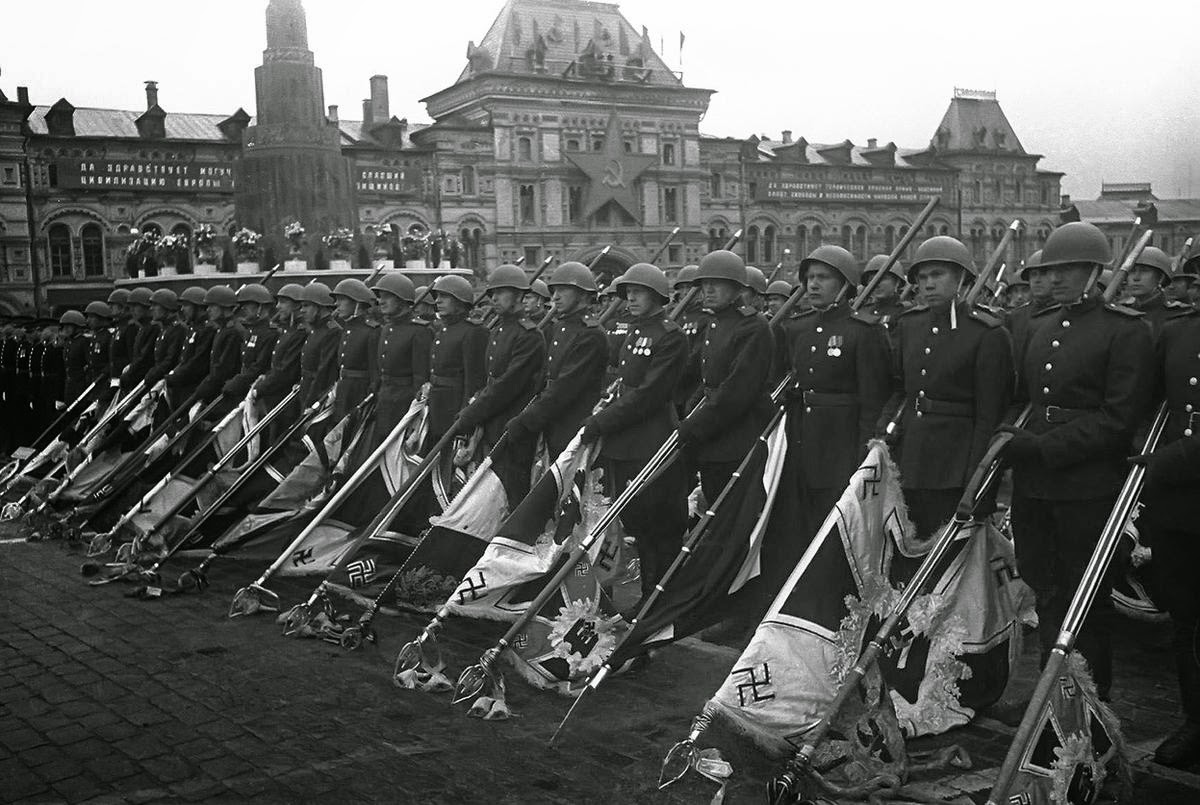
Victory Parade, Moscow, 24.6.1945
Detail of the Soviet War Memorial Treptower Park,
Berlin, April 2010
Today, exactly 70 years after that day. The day of surrender. 70 years after the defeat of the Nazist - Fascist hordes, the effort to rewrite history is more intense than ever. The aspiring distorters and counterfeiters of history know very well that the preservation of  the collective memory has not so much to do with the past, as it has to do with the present and the future. So do we! And every year, this specific day, we will repeat loud and clear that: 

"If someone examines the corpse of fascism, he will see that has many wounds, from simple scratches to deep injuries. But only one wound was deadly and this was caused by the Red Army."

"The Homeland will never forget their heroes".
Soviet War Memorial Treptower Park, Berlin, April 2010


Struggle against oblivion. Struggle for today and tomorrow!
Carlos Latuff, May 2015
In memory of the Great Antifascist Peoples' Victory.
 In memory of Man!

Τρίτη 7 Οκτωβρίου 2014

The Revolt.


...But he who has seen the slain
Writhing in final pain
Under the blood-drenched sword.
He knows of better realms...


Saturday, 7th October 1944, Auschwitz camp was upset. The silence of the sunny autumn day was interrupted by sudden gunshots and the siren's howling, which this time was not a warning for another air raid, as usual. A column of fire and smoke was coming out from the building of crematorium no. 4. Terrific news were spreading across the whole camp: The Sonderkommando prisoners mutinied! They rebelled with guns in their arms and they fight against the SS.

Cremation of bodies by the Sonderkommando,
Auschwitz - Birkenau, August 1944.
 (Photo taken secretly by the camp's resistance network) 
The revolt was preparing for a long time before October 7th. Already since summer of 1944 member of Sonderkommando were gathering tools, ammunition, grenades and light weapons for a possible future assault against the SS. The leader of this first attempt for organizing, a Lithuanian prisoner (who was serving as a Kapo) called Kaminsky, had been betrayed and executed by the Nazis. The operation had been postponed for a few weeks but it continued after a while when the circumstances allowed it. As the Soviet Army was advancing towards Krakow the, almost 800, prisoners working in Sonderkommando were a serious threat for the administration of the camp. These prisoners were the only (not Nazi) eyewitnesses of the extermination process which was taking place in Auschwitz - Birkenau. They couldn't work anywhere else inside the camp and no one should be stay alive. The SS were saying ironically that they have secured a ticket to paradise! 

The underground resistance movement which was active in the Auschwitz complex was planning a general uprising involving every part of the camp. The Sonderkommando prisoners, as they had nothing to loose, were the chosen ones to light the fire of this uprising, but they had to wait few more days before all the necessary preparations were completed. 

The exterminate fury of the Nazis changed the plan of the resistance's organisation. Sonderkommando had to act immediately as it was facing its total extinction! Already 300 prisoners had been secretly exterminated on September 29th and the same fate was waiting the rest of them few days later... The morning of 7.10.1944 the resistance group had a secret meeting about the last details of the revolt. A Kapo wearing a green armband (stands for native Germans, common criminals) comes accidentally into the room. That was! Some prisoners threw him alive into the oven as others took out the hidden weapons and got defensive positions in the small forest behind the building. Crematorium no.4 had already been in flames! 

The revolt had begun! Prisoners from Crematorium no.2 got into the fight too. For the rest hours few hundred prisoners were facing heroically almost 3000 SS units. 200 hundreds prisoners will fall in that battle for freedom and only few will manage to escape the camp...


The next days a true witch-hunt will take place in Auschwitz. The SS wanted to find out any possible information related with the organisation of the revolt. They failed completely... Noteworthy was the attitude of four female prisoners working in the nearby "Union" factory (owned by the Krupp family). They were accused for smuggling gunpowder to the resistance members. Despite months of beatings and rape and electric shocks to their genitals, the only names given up by the women are those of already dead Sonderkommando. On January 5, 1945, the four brave women are hanged in front of the assembled women’s camp. One of them, Roza Robota shouts “Be strong and be brave” as the trapdoor drops.

Women being taken to the gas chamber,
Auschwitz - Birkenau, August 1944.
(Photo taken secretly by the camp's resistance network) 
The revolt in the Birkenau crematoriums was the only armed conflict took place in Auschwitz and one of the few known acts of resistance that happened in the huge network of the Nazis concentration camps. The political and moral impact of this action was enormous. It raised the spirit of the inmates and made them to trust their own powers. Their belief to victory became stronger. The revolt showed that even a small group of prisoners, despite their condition, can face thousands fully armed SS. As the Nazis couldn't reinforce the SS guard of the camp, they forced to abandoned their primary plan for the massive extermination of the prisoners and they evacuated the camp instead.We can claim, even if it can not been proved, that the revolt of Sonderkommando put a premature end to the extermination process of this death factory, saving thousands of lives.  


... And yet i 'd rather die,
Your spittle in my eye,
Rather die as a coward,
Than have blood on my hands...

Δευτέρα 27 Ιανουαρίου 2014

Death is afraid of Leningrad...

Defend Leningrad

...I came in and said: Papa i won't eat my bread ration. If i will stay alive i want to saw 
to post generations what kind of bread we had to eat during the siege. My father said 
"You 'll die". I said if i eat it, i still may die and perhaps even if i don't eat it i may still 
stay alive. It was so terrible. That's why i wanted to keep that bread, so the children 
could see and know how we lived. It's hard to imagine now what we had to endured 
during the block period to survive...

...Above all when you recall it you are astonished by the strong belief people had in 
their victory. At the time when things were so harsh there were no ground at all for 
such a relief. Take evacuation for instance. It was a much more difficult problem than 
trying to get supplies to the front line. It was hard to persuade people to leave the 
city, they just wouldn't move, they said: "we 'll win, we 'll beat the enemy soon, i am 
not moving any place" Even today i can't really understand some things...

Youth of the City of Lenin!Let our selfless work help the Red Army to crush and destroy the enemy!
... In those days you needed greater courage to live than to die! People worked long 
shifts. 16, 20 hours per day despite the hunger and cold. As Leningrad's history put it: at 
night the occasional flicker of fires and the red flash of exploding artillery shells were 
the only source of light into the darkness! But Leningrad was seemed to possessive 
an indestructible will to survive...


Leningrad is not afraid of death they said. Death is afraid of Leningrad!

872 days under siege, the city of Lenin never surrendered. It was 27th of January 1944 when the Soviet Red Army managed to lift the blockade (started 8th of September 1941) and push back the Nazi forces.